A Funding Round Is a Headline, Not a Buying Signal

A Funding Round Is a Headline, Not a Buying Signal
Published: June 2026
A company you would love to sell to raises a Series A. The alert lands in your inbox at 9am. It also lands in the inbox of every other rep selling something similar, at the same 9am. By lunch the founder has thirty "congrats on the raise" emails sitting unread, and yours is one of them.
The round is real. The opportunity might be real. But the thing everyone just treated as a buying signal, the funding itself, is the weakest part of what you actually know. It tells you a company has money. It does not tell you whether they are spending it, what they are spending it on, whether they have started, or who signs off. Those four blanks are the difference between an email that lands this week and one that gets archived.
This is a piece about timing. Specifically, about why funding alone is a poor timing signal, and what you have to read alongside it to know when a funded company is genuinely in the market for what you sell.
Why funding on its own is a weak signal
Funding proves capacity. It does not prove intent, and it says nothing about timing.
A round closing means a company can spend. It does not mean it is spending, or that it will spend on your category, or that the spending starts now rather than two quarters from now once the new VP has finished their notice period. Plenty of companies raise and then sit on the cash for months while the board argues about the plan. From the outside, the announcement looked like a green light. Inside, nothing moved.
So the headline hands you one fact, money exists, and leaves you to guess the three that actually decide whether outreach works:
- Where is the money going?
- Has it started moving yet?
- Who do you talk to?
Guessing those is what separates the rep who books the meeting from the twenty-nine who got archived. The good news is that you do not have to guess. Each of those blanks has a signal that fills it.
Where the money is going
Read past the headline of almost any funding announcement and the company tells you the plan. "Funds will accelerate go-to-market." "Investment in our research team." "Scaling infrastructure to meet demand." The detail is in there. It is just buried under the dollar figure that everyone quotes back.
Fundup AI reads that announcement and pulls the plan out as structured Spend Intent signals: where the company says the capital is going, by category, with a confidence rating and a link to the source it came from. R&D, product, infrastructure, marketing, hiring, sales. If you sell developer tooling and a company just earmarked its round for engineering and infrastructure, that is a very different conversation than the same round pointed at a retail expansion.
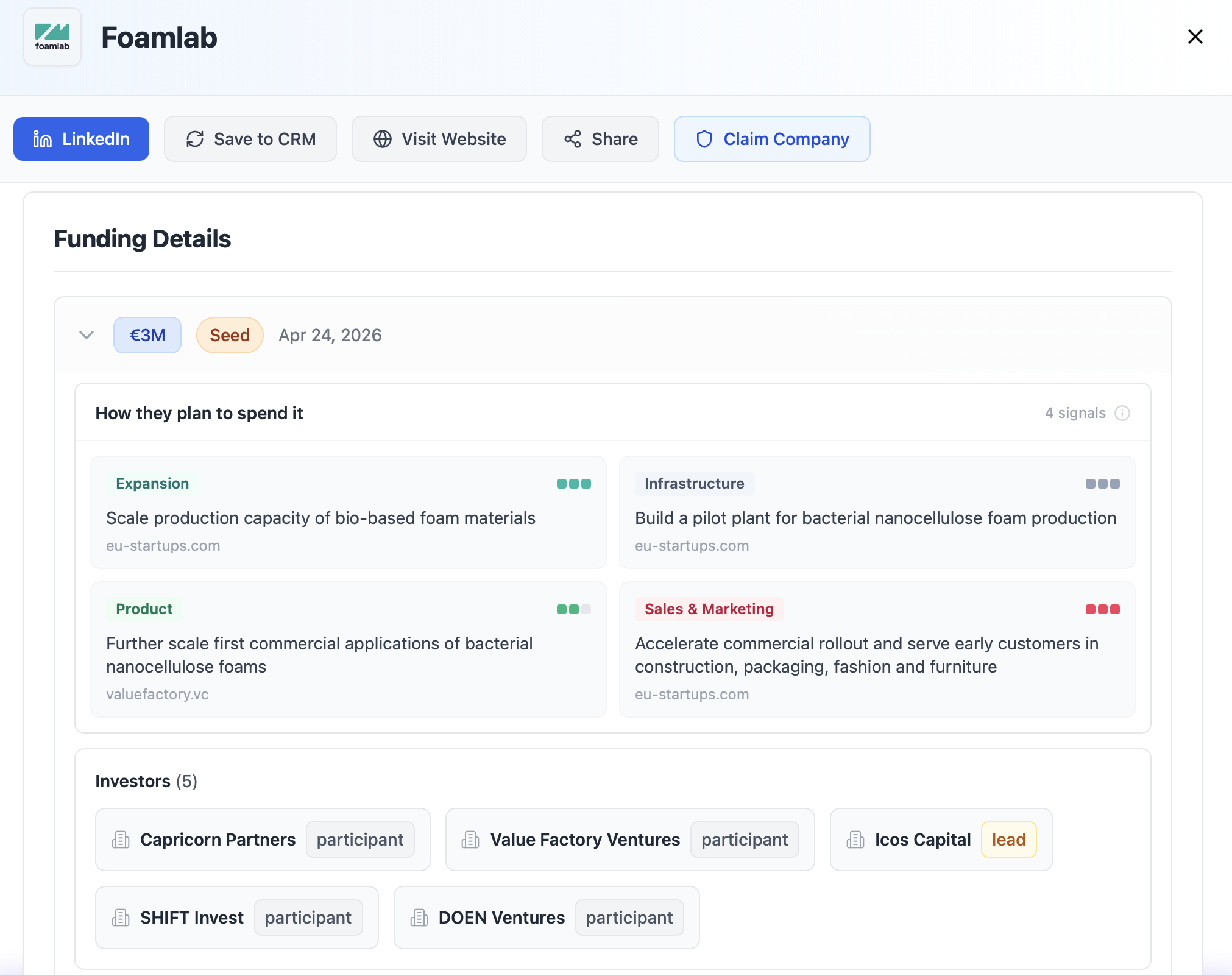
That is the first blank filled. Not "they raised," but "they raised and said the money is going to the thing I sell into." We went deeper on how this works in Spend Intent Intelligence.
Stated intent, though, is still just intent. A plan in a press release is not a budget that has started moving. Which is the second blank.
Whether it has started moving
A founder can announce "we are hiring twenty engineers" and then do nothing about it for a quarter. The careers page is where you find out which it is.
When a company posts a role, somebody inside has signed off on a requisition, a budget line, and a reporting structure. That is the earliest visible moment that capital touches the real world. Fundup AI reads every funded company's live open roles continuously and turns them into named Hiring Signals, classified by department, seniority, and pace.
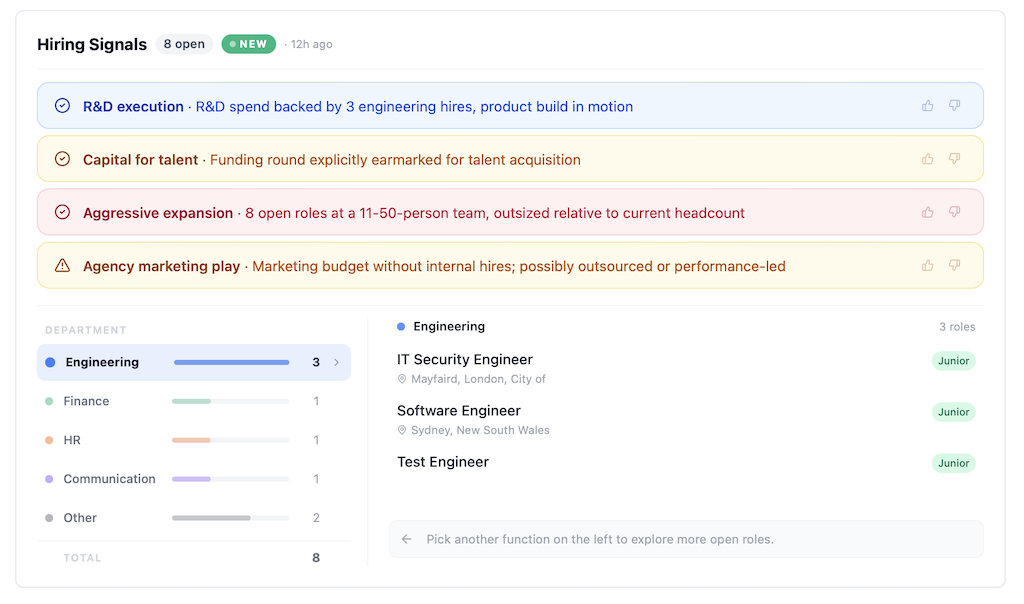
The useful part is reading hiring against spend intent, because the two together describe a company's real trajectory better than either one does alone. Three patterns are worth memorizing:
- The company said sales, and there are sales hires live right now. The budget is moving. The window is open, not coming.
- The company said sales, and there are no sales hires yet. The money and the stated direction are there, the execution has not started. This is the early account your competitors skip because nothing obvious is happening. The first hire against that plan is your moment.
- There are hires the last announcement never mentioned. Something changed since the press release, and it is worth understanding what.
That middle pattern is the one most people miss, and it is often the most valuable one on the list. More on the mechanics in Hiring Signals: When Capital Becomes Headcount.
Reading the signals together
Any one of these is a data point. The value is in seeing them on the same company at the same time.
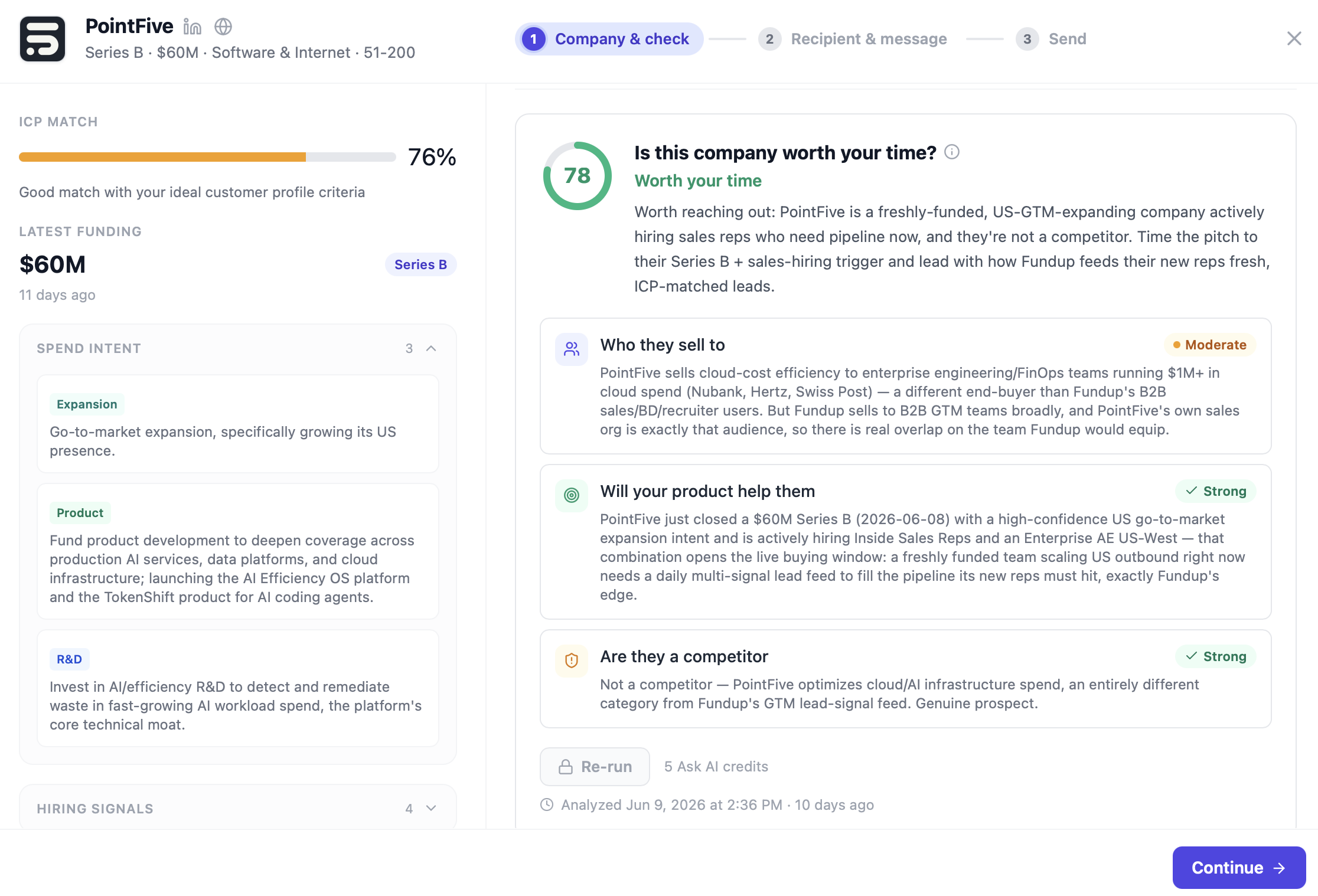
Open a funded company in Fundup AI and the picture is assembled for you: the round and its size, what the company said the money was for, whether the hiring backs that up, and the fit against your own ICP criteria. A judgment that used to take an hour of LinkedIn tabs and press-release skimming becomes a glance.
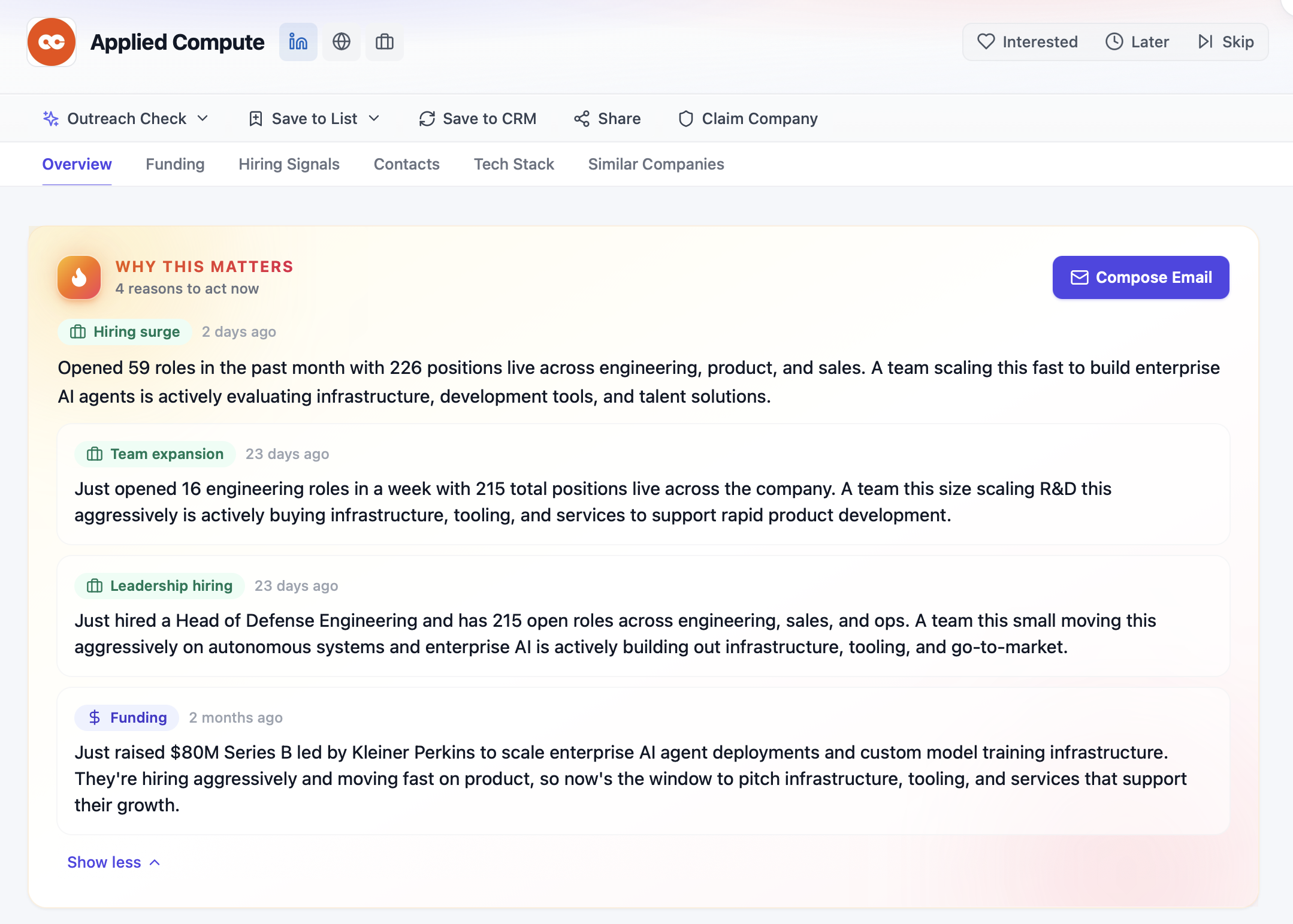
This is the entire argument in one screen. Funding told you the company exists and has money. Spend intent told you where the money is pointed. Hiring told you whether it has started moving. Read in isolation, each one is a maybe. Read together, they are a qualification.
Who you actually talk to
The last blank, and the one that quietly kills good timing. You can read every signal perfectly and still have nowhere to send the email.
For a funded company, Fundup AI surfaces its key contacts straight from public professional data: name, title, and LinkedIn profile. That alone answers a question that usually costs you twenty minutes of LinkedIn. Who do you actually thread? The VP of Engineering rather than the founder. The new head of sales rather than the ops lead. The person whose budget the signal you just read is about to land on.
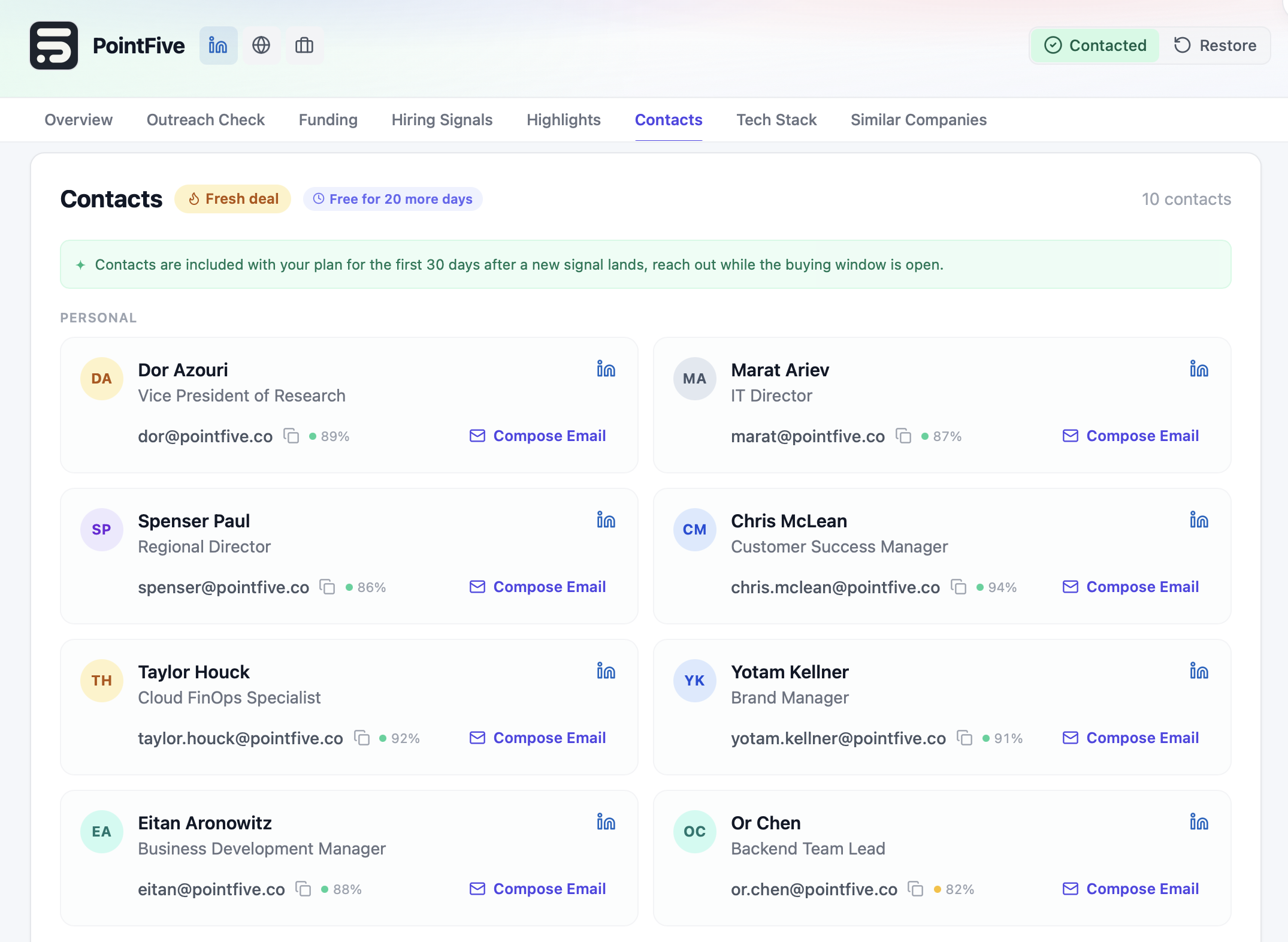
Once you have picked the right person, you reveal their verified business email in place, and it is cached on the company so you never pay to look it up twice. Companies funded in the last thirty days are free to reveal, which is exactly the window this whole piece is about. If the people listed are not the ones you want, you can search the company by department and seniority and pull the right person in.
So the signal stops being a company and becomes a person. That is the only form a signal can be acted on, and it sets up the last step.
Timing, in practice
There is a well-documented window after a company raises. Research on venture-backed firms shows they grow faster, hire harder, and build out their stack earlier than comparable companies that did not raise. The first twelve to eighteen months after a round is when budgets are fresh, decisions move quickly, and a company is open to new vendors instead of locked into incumbents. We pulled that data together in Why Recently Funded Companies Are Your Best B2B Sales Targets.
The window is real. Finding funded companies has never been the hard part, everyone sees the same announcements. The hard part is knowing which of them is actually in motion right now, and reaching the early ones before the activity becomes obvious to everyone else.
That is what reading the signals together buys you. A confirming pattern, stated intent plus matching hires, means the window is open today. A divergence pattern, intent without the hire yet, means you are early, ahead of the pack, on an account that will be obvious to your competitors in ninety days.
From signal to the email you send
None of this matters if it stays a dashboard you admire. The point of reading the signals is to change the email that goes out.
When you go to reach out to a company in Fundup AI, two things happen before you write a word. First, an Outreach Check: the model grades how good a fit the company is for what you sell, scoring it against your own saved company profile and using the full signal picture, every round, the spend intents, the live hiring, the ICP score. If the fit is poor, you find that out before you spend a minute on it. Second, if it is worth pursuing, the draft is written from your profile and the company's live signals, so the opening line references what they are doing with the money and who they are hiring, not just that they raised. You edit from there and send.
"Saw the round, and that you are pointing it at infrastructure while staffing up the platform team" is a different opener than "congrats on the raise." One shows you read past the headline. The other shows you sent a template. The signals are not there to be looked at. They are the raw material the email is built from.
The short version
Funding tells you who. It does not tell you when, where, or what to say. Spend intent tells you where the money is pointed. Hiring tells you whether it has started moving. Verified contacts tell you who to reach. Read together, in one place, they turn the guess that everyone else is making into a call you can actually time.
That is the whole reason Fundup AI stopped being a funding tracker and became a multi-signal one. The headline was never the signal. It was just the part everyone could see.
Want to see this on your own accounts?
Open Fundup AI and look at any funded company. The signals are already there, waiting to be read together.
Sources:
- Synergising ventures: The impact of venture capital-backed firms on the aggregate economy, VoxEU
- Federal Reserve Bank of Atlanta and University of Chicago research on the growth of venture-backed firms


